
FROM SCAN TO SHOWROOM
NOT DISCLOSED
Automotive Digitisation
Year
2025 · Technology update 2026
Design
Ignition VR
Category
Automotive Digitisation
Visualisation
INNA 3D
Software used
ABOUT
From Scan to Digital Asset
A 3D scan captures a car. It does not create a production-ready digital asset.
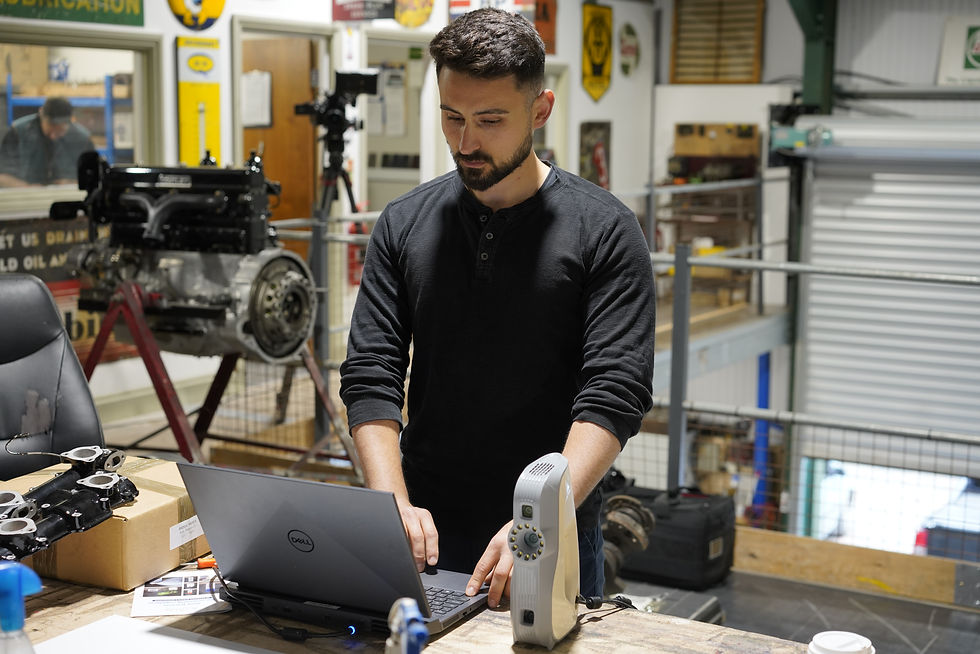
Working with scanning partner Ignition VR, we developed a complete automotive digitisation workflow that takes measured vehicle data and turns it into usable 3D — from editable CAD and high-end CGI to real-time experiences.
The original scan remains the source of truth. From there, geometry is cleaned, rebuilt and optimised for its final purpose, while materials, UVs and topology are developed for visual production. The result is not one oversized model forced into every application, but a family of accurate digital assets built around the same physical car.


The Brief, Closed
ONE CAR. EVERY DIGITAL USE.
A production-ready digital twin should not be one model pretending to do everything.
Engineering needs editable surfaces. CGI needs controlled topology, UVs and materials. Configurators and VR need efficient real-time geometry. Each version has different requirements, but every one can originate from the same verified scan.
That is where digitisation becomes valuable beyond a single project. Once the vehicle exists accurately in 3D, it can generate new imagery without another photography session, support restoration and engineering work, become part of a museum experience, or move directly into an interactive configurator or digital showroom.
AI now accelerates parts of that process — from masking and material extraction to repetitive remeshing — but anything affecting proportion, fit or accuracy remains tied back to measured geometry.
3D Scanning: Ignition VR · Digital Asset Production & Visualisation: INNA3D · Automotive Digitisation · 2025–2026.